



Route optimization software is essential for improving the efficiency of transport and delivery operations. These tools help plan and optimize routes, reduce costs and distances traveled, respect time windows and operational constraints, and enhance customer satisfaction.
With so many solutions available on the market, it can be difficult to navigate differences in features, underlying technologies, targeted industries, usability, and adaptability to specific business needs.
This guide compares the best solutions on the market (Kardinal, PTV OptiFlow, Geoconcept, Aptean, Descartes, Route4Me), analyzing their strengths, limitations, and the contexts in which they perform best, to help you choose the tool that best suits your fleet and logistics requirements.
What criteria should you consider when choosing route optimization software?
Choosing route optimization software means finding a reliable and efficient partner to simplify the planning of your operations. Given the variety of solutions on the market, it’s essential to identify criteria that ensure the chosen tool fits your operational needs and organization.
✅ Key features
A good software does more than calculate a simple route. It should handle multiple constraints specific to your activity, such as:
- Dynamic optimization of stop sequences to adjust in real time based on on-the-ground conditions.
- Accurate consideration of operational constraints: vehicle capacities and types, delivery time windows, required technical skills for tasks.
- Complete management of work schedules and breaks to comply with regulations and maintain employee well-being.
- Integration of historical traffic data, real-time traffic, and road disruptions.
📱 Usability and accessibility
The effectiveness of software also depends on its adoption in the field. The interface should be:
- Clear and intuitive, even for users less familiar with digital tools.
- Available in the user’s language to ensure full understanding of features and displayed data.
💰 Flexible and scalable pricing
When choosing a solution, consider its overall cost and financial flexibility:
- Check for a free version or trial period to test the tool before committing.
- Ensure the plan can easily scale with your fleet size and needs, without hidden fees or major technical constraints.
- Favor a solution that can support business growth, from small local operations to national fleets.
🔗 Seamless integration with your digital ecosystem
A powerful route optimization tool should fit into a connected digital environment. Key points to check:
- Compatibility with your existing systems (TMS, DMS, ERP, CRM, etc.)
- Availability of open APIs for custom development
- Connectivity with related tools, such as proof-of-delivery management or parcel tracking
🧑💻 Reliable customer support and long-term dependability
Finally, a crucial criterion is the vendor’s support:
- Responsive and accessible support, ideally in real time or during hours suited to your operations
- Comprehensive documentation and learning resources
- Regular update roadmap to keep pace with business and technological changes
- Local presence or personalized follow-up to ease deployment and adoption
Our selection of the 6 best route optimization software solutions
Kardinal
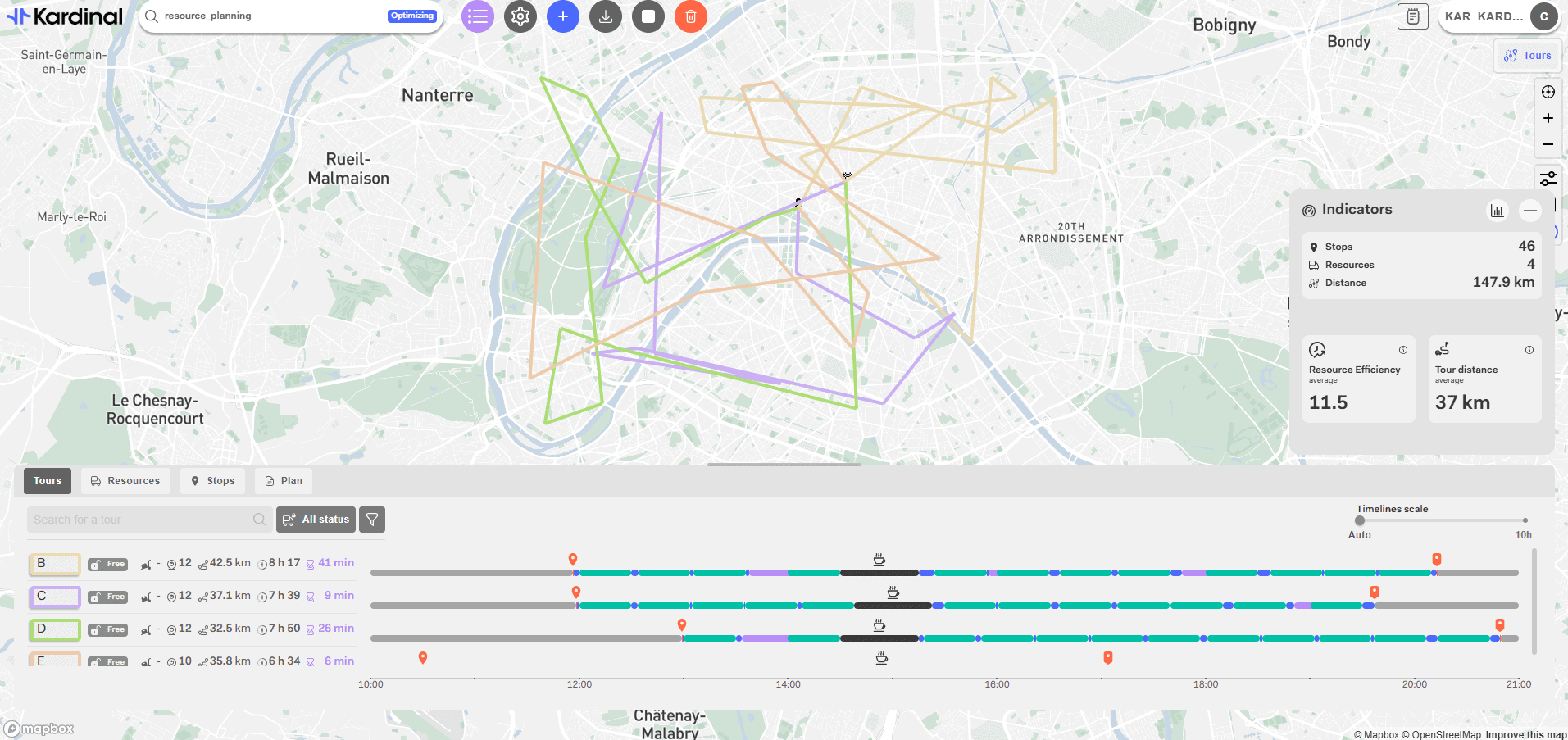
ARO (Always-on Route Optimization) is a SaaS route optimization solution developed by the French company Kardinal, founded in 2015. Designed for a wide range of sectors (including parcel delivery, e-commerce, waste transport, bulk delivery, field services, and urban errands), the platform handles complex operations anywhere. To provide a seamless, integrated experience, Kardinal has established technical partnerships with numerous TMS and DMS providers, including Hub One, Acteos, Akanea, Escher, Everest, and Urbantz.
Client examples: DPD France, Ciblex, Vente-unique, Séché Environnement, Glasseo, Novea (Groupe Sterne), Saretec…

✅ Key strenghts
- Expert in customized optimization: Kardinal’s R&D team, including several PhDs in applied mathematics, develops algorithms that integrate complex, industry-specific constraints often missing in standard solutions, delivering more realistic and relevant route planning.
- Continuous optimization: Unlike traditional approaches where routes are fixed after initial calculation, ARO continuously updates routes in real time, adapting to changes or unexpected events without recalculating everything from scratch.
- Predictive traffic integration: The solution anticipates traffic conditions to produce feasible and coherent routes from the planning stage.
- Clear and intuitive interface: Modern interface designed for quick onboarding and smooth daily navigation.
- Rapid deployment and responsiveness: ARO can be operational in under a month. Kardinal stands out for its technical team’s proximity and ability to respond in real time, with fast updates and adjustments.
- Continuous innovation: Kardinal offers complementary solutions to optimize the entire transport chain: TAO (intelligent delivery depot sectorization), ODA (smart delivery time slot planning), and Laskar (mobile app for drivers to plan and execute routes).
- Gartner recognition: Kardinal is listed as a Representative Vendor in the 2025 Gartner Market Guide for Vehicle Routing & Scheduling (VRS), confirming its credibility and relevance in route optimization.
⚠️ Limitations
- Primarily for medium to large fleets: Kardinal’s approach, designed for complex constraints, mainly targets large or multi-site operations. Smaller operations can use it via API but need technical resources for integration.
- New mobile app: Laskar, though promising and already used daily by many drivers, is still new, with limited public reviews, which may concern cautious users.
- No native Proof of Delivery (POD): Kardinal doesn’t include built-in signature or parcel scanning. Third-party tools can be connected via API.
Continuous route optimization solution

PTV
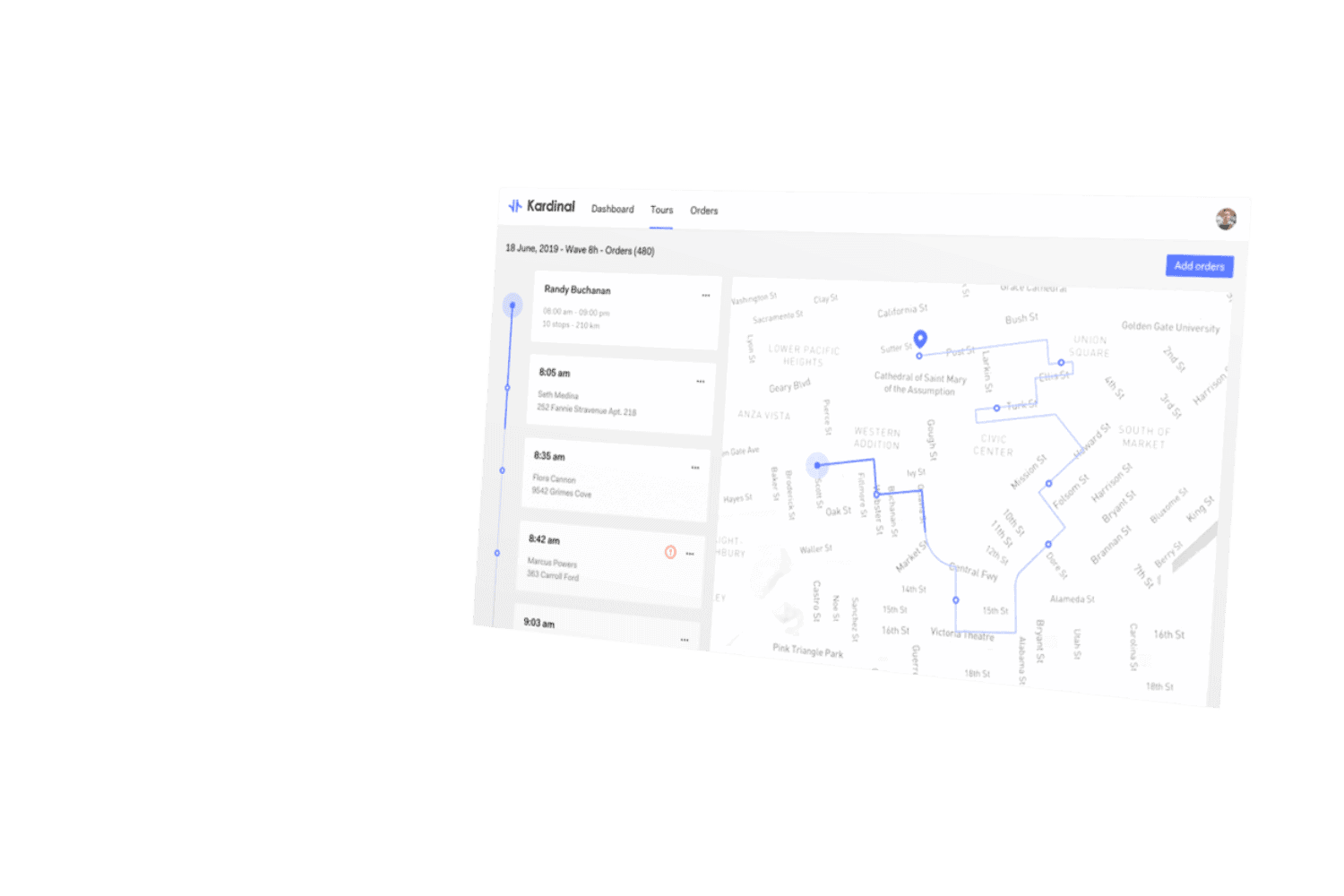
PTV OptiFlow, developed by the German group PTV GmbH, is a powerful and versatile route optimization software. Suited for multiple sectors (freight transport, construction, sales rounds, waste collection), it serves large companies and public authorities in over 120 countries.
The tool offers all key features: staff constraints, customer availability management, vehicle load optimization, real-time route tracking with geolocation, ETA notifications, and potential fuel and CO₂ savings calculations.
Available as SaaS, on-premise, or via web app, PTV OptiFlow integrates into IT ecosystems with around ten APIs, often available for testing by IT teams.
Clients include: HelloFresh, CleanLease, Ahold Delhaize, Dynalogic.


✅ Key strenghts
- Proven expertise: Over 40 years of experience in route optimization and mapping, making it a trusted choice for large companies and complex projects.
- High-volume capability: Can optimize up to 15,000 orders simultaneously, enabling fast planning for very large fleets.
- Extensive functionality: Beyond route optimization, it offers scenario simulation, logistics cost analysis, and compliance with regulatory and environmental constraints.
- Global presence: Operates in over 120 countries with localized maps and regulations, ideal for companies with European or worldwide operations.
⚠️ Limitations
- Delayed cloud adoption: Originally on-premise, PTV took longer to develop a fully optimized SaaS/cloud-native version, which may deter companies seeking a 100% cloud solution.
- Steep learning curve: Some users report that onboarding requires significant time and training.
- Customer support: Feedback suggests ongoing support could be improved for more consistent guidance throughout projects.
- No dedicated mobile app: Lack of a main mobile app (Play Store/App Store) may limit field usage.
Geoconcept
TourSolver, originally developed by Geoconcept and now part of Nomadia since 2021, targets sectors like food, energy, waste management, healthcare, and field services. It offers TourSolver Cloud (online) and AppTourSolver (iOS/Android).
The software integrates with popular business tools such as Microsoft 365, Google Workspace, QuickBooks, and Salesforce, facilitating seamless adoption within existing IT environments.
Clients: C Chez Vous, Potager City, Domino’s Pizza, Proserve Dasri.


✅ Key strenghts
- Intuitive interface, particularly appreciated on mobile, with clear schedule visualization.
- High level of customization, considering over 150 business criteria (time windows, geographic constraints, human resources, delivery volumes, etc.).
- Fine adaptation to sector-specific vocabulary and activity types (visits, interventions, deliveries).
- Comprehensive mobile app enabling field teams to access schedules, visit sheets, GPS tracking, and provide real-time updates, improving communication between field and back-office.
- Recognized by Gartner: Geoconcept (TourSolver) cited in the 2021 Gartner Market Guide for Vehicle Routing & Scheduling (VRS), highlighting its strategic positioning among advanced route optimization solutions.
⚠️ Limitations
- The high level of customization can make onboarding more complex, especially for new users, often requiring dedicated guidance or support.
- Some users encounter difficulties managing and integrating client databases into the system.
- Feedback suggests that technical support could be more responsive to better address urgent needs.
Aptean
Aptean Routing & Scheduling, formerly known as Paragon, is a route planning and optimization solution used for decades by distribution, transport, and service companies across multiple countries.
The engine supports multi-depot, multi-day, and multi-constraint operations, including time windows, vehicle capacities, driver rules, and delivery priorities. The suite includes modules for daily planning, real-time optimization, strategic simulation, and territory definition.
The tool can be deployed on-premise or in a cloud environment and integrates with TMS, WMS, ERP systems, and telematics solutions.
Example clients: Warburtons, SIG, Wincanton, CEVA Logistics, John Lewis Partnership.


✅ Key strenghts
- Proven technology: a route optimization engine used for complex planning.
- Suitable for large fleets: can handle high volumes with various operational constraints.
- Simulation capabilities: allows testing different scenarios to assess logistics performance.
- Integration ecosystem: connects with business systems and fleet tracking solutions.
⚠️ Limitations
- On-premise heritage may result in longer deployment phases.
- Interface may require a learning period for some users.
- Implementation costs are generally higher than fully SaaS alternatives.
- Product updates may be slower compared to newer solutions.
Descartes
Descartes Route Planner, part of the Descartes Routing & Scheduling suite, is used by transport, distribution, and retail companies across multiple regions worldwide.
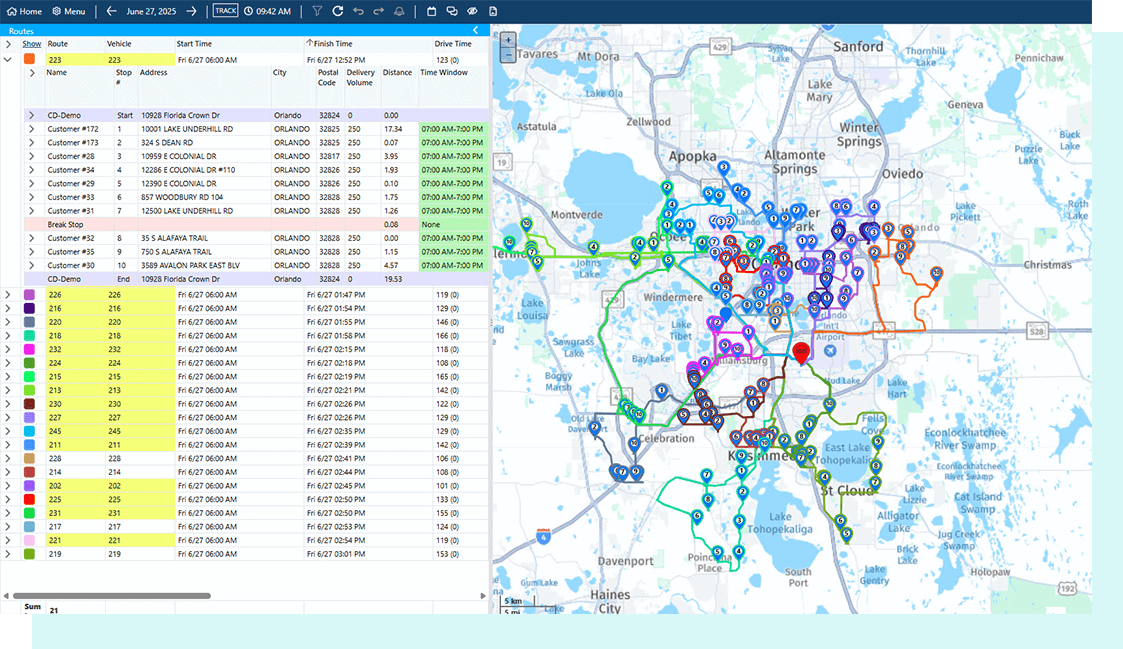
The platform covers daily planning, real-time dispatch, dynamic optimization, route monitoring, and customer appointment management. It supports a wide range of constraints including service times, schedules, vehicle types, geographic zones, customer preferences, and driving rules.
Descartes offers a cloud-based solution integrated with order management systems, telematics tools, and a mobile application for drivers.
Example clients: Walmart Canada, Peapod Digital Labs (Ahold), Blue Apron, British Gas, Henry Schein.

✅ Key strenghts
- Broad functionality: planning, execution, monitoring, and customer communication.
- Adapted for last-mile delivery: slot management, ETA calculation, real-time tracking.
- Scalable: capable of managing large volumes of orders and vehicles.
- Regular updates: ongoing improvements for cloud modules.
⚠️ Limitations
- Configuration can be complex for organizations with highly specific processes.
- Implementation often requires significant consulting support.
- Interface may feel inconsistent across some modules.
- May be over-dimensioned for companies seeking a simple planning tool.
Route4Me
Route4Me is a widely used route optimization software developed in the United States, primarily targeting small and medium-sized businesses as well as independent operators in delivery, freight transport, field services, and retail.
The solution is available as a SaaS via an intuitive web platform and offers mobile apps for iOS and Android, making route planning, management, and real-time tracking easy.
Client examples: Accenture, Chipotle, USPS, Coca-Cola, FedEx…


✅ Key strenghts
- Easy-to-use interface with a clear design, suitable for users without optimization expertise.
- Quick setup: bulk import of customer data via Excel or CSV to create routes in minutes.
- Flexible pricing with plans tailored for small businesses, including pay-as-you-go options without long-term commitment.
- Efficient mobile apps allowing drivers to receive routes, record deliveries, and report incidents.
- Wide range of integrations with CRMs, e-commerce platforms, and management tools such as Salesforce, Shopify, and QuickBooks.
⚠️ Limitations
- Optimization algorithms may be less effective for complex cases with many specific constraints.
- Route customization is limited compared to more advanced or tailored solutions.
- Some users report slow processing with very large data volumes.
- Customer support can be less responsive, especially outside U.S. business hours.
Comparison table of the best route optimization software
Solution | Description | Key strenghts | Limitations | Recognized by Gartner (VRS Guide) | Kardinal (ARO) | French SaaS route optimization solution, suitable for many sectors, integrated with multiple TMS/DMS. | – Custom algorithms for complex constraints – Continuous optimization – Predictive traffic consideration – Fast deployment and highly responsive customer support | – Mainly targets mid/large accounts, but API allows smaller businesses to benefit – Recent mobile app with few public reviews | Yes, 2025 |
|---|---|---|---|---|
PTV OptiFlow | Powerful, versatile German software, suitable for large enterprises and public authorities, available SaaS and on-premise. | – Over 40 years of expertise – Optimizes very large volumes – Advanced features and simulation – International coverage | – Late full SaaS deployment – Complex onboarding – Customer support could be improved – No dedicated mobile app | No |
Geoconcept (TourSolver) | French software now part of Nomadia, with cloud and mobile versions, highly customizable. | – Intuitive and mobile-friendly interface – Over 150 business-specific criteria – Full mobile app | – Steep learning curve – Challenges integrating client databases – Technical support could be improved | Yes, 2021 |
Aptean | Enterprise-grade American route optimization and workforce management solution, suitable for transport, field services, and delivery operations. | – Strong ERP and back-office integrations – Advanced scheduling and route optimization – Scalable for large fleets | – Mainly enterprise-focused – Can be complex for small operations – High cost | No |
Descartes | Canadian SaaS platform for route planning, delivery management, and logistics optimization, widely used in transportation and e-commerce. | – Proven global deployment – Comprehensive delivery and route management – Integration with multiple logistics platforms | – Can be complex to implement – Premium pricing – Mobile app features may vary by region | No |
Route4Me | Widely used American SaaS, targeting SMEs and independent operators, with effective mobile apps. | – Easy to use – Fast setup – Flexible pricing – Effective mobile apps – Various integrations | – Algorithms less effective on complex large-volume cases – Customer support could improve | No |
Conclusion
Route optimization software has become a key strategic lever for any organization looking to improve operational efficiency and service quality. Whether you manage a small local fleet or a large logistics network, choosing a solution that fits your business constraints, activity volume, and digital maturity is essential.
Each software presented here comes with its own strengths, weaknesses, and unique features. The key is to prioritize a solution that can integrate smoothly with your IT system, support your teams in the field, and evolve alongside your needs.
At Kardinal, we believe an effective optimization tool must go beyond simple route calculation: it should closely reflect on-the-ground complexity, adapt in real time to operational uncertainties, and provide robust, agile decision-making for both operators and drivers. This is what makes our solution strong and valued by our clients, who experience tangible operational benefits every day.
In a context where customer, environmental, and regulatory demands are constantly increasing, route optimization is no longer optional, it is imperative for remaining competitive and sustainable.
💡Want to learn more about our route optimization solution?
Contact us for a demo and discover how Kardinal can support your organizational transformation.