



In a nutshell
Route optimization refers to the set of algorithmic and organizational techniques designed to automatically calculate the most efficient itineraries for a vehicle fleet, taking into account time, capacity, and cost constraints. Despite proven promises (fuel cost reductions of 10 to 30%, productivity gains of 15 to 25%) many projects fail to deliver their expected benefits. The main reason is not technological: it is the absence of three essential foundations.
The 3 pillars of a successful route optimization project:
- Tailored business modelling, supported by the provider
- Reliable data, accessible and adjustable in real time
- Effective change management to bring field teams on board
In this article, we break down each of these pillars and explain how to implement them to maximize your chances of success.
What is route optimization?
Route optimization (or delivery route optimization) is a process that consists of automatically determining the most efficient stop sequences for delivery or service vehicles, minimizing costs (distance, time, fuel) while respecting all operational constraints: customer time windows, vehicle capacities, driver skills, labor regulations, etc.
It relies on combinatorial optimization algorithms, variants of the Travelling Salesman Problem (TSP) or the Vehicle Routing Problem (VRP), integrated into route management software.
Why has route optimization become essential?
Distribution companies, last-mile logistics operators, and field service businesses face growing pressures: rising fuel costs, next-day or same-day delivery requirements, CO₂ emission reduction challenges, and driver shortages. In this context, manually planning routes is no longer sufficient. Optimization solutions can handle dozens or hundreds of constraints simultaneously, where a human planner reaches their limits beyond a few dozen stops.
Pillar #1: Business modelling — Why generic solutions fall short
What does modelling mean in a route optimization tool?
Every company has its own realities: service areas, customer profiles, vehicle types, contractual constraints, and operational habits. Modelling refers to a tool’s ability to translate these specific business rules into constraints that the algorithmic engine can process, without compromising operational quality.
It goes far beyond standard parameters (vehicle capacity, opening hours, service duration) to integrate specificities such as:
- Split deliveries (a single customer served by multiple vehicles)
- Driver skills (certifications, special licences, languages)
- Variable time window zones (markets, pedestrian areas, night deliveries)
- Differentiated service levels by customer type or contract
- Product compatibility constraints (temperature, hazardous materials)
What are the limits of off-the-shelf solutions?
Most “off-the-shelf” solutions or TMS-integrated engines offer a motor limited to this standard foundation. As soon as the context becomes more complex, they quickly reach their limits and produce theoretically optimal but operationally unworkable routes.
For planning to remain relevant even in complex contexts, the solution must:
- Model the diversity of business constraints: not only standard constraints, but also local or sector-specific requirements
- Adapt to operational changes: new contractual rules, changes in time windows, customer priorities, fleet adjustments
- Enable simulations and predictive analyses: test different scenarios to anticipate impacts on productivity, costs, and customer service before any field deployment
A powerful optimization engine does not simply produce “optimal” routes on paper: it must generate plans that are actionable and reliable for field teams.
What role does the provider's support play?
Modelling work is rarely static: business rules evolve, data changes, and new constraints regularly emerge. A good route optimization provider does not just deliver software: they co-build the model with operational teams. This involves:
- Tailored support: translating operational needs into actionable rules, advising on how to prioritize the most critical constraints, personalized adjustments based on the company’s context
- Co-construction with field teams: regular working sessions to gather feedback, identify pain points, and validate proposed models
- Training and knowledge transfer: operational teams must understand how the tool works in order to fully leverage its capabilities and quickly flag inconsistencies
- Ongoing support: the provider must follow the project over the long term, adapt the model as the company evolves, and anticipate future needs rather than settling for a one-time implementation
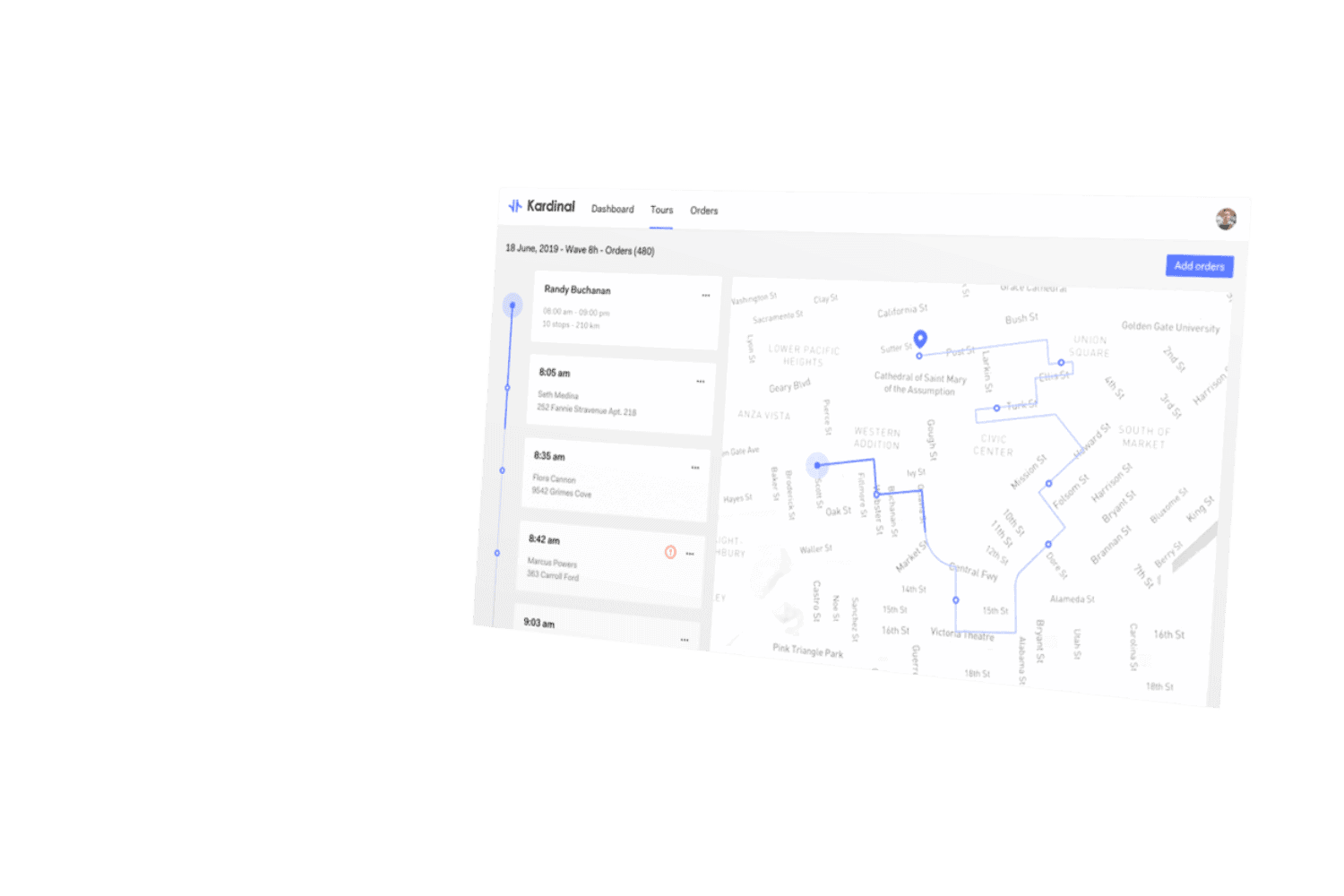
By combining rich and flexible modelling capabilities with proactive human support, companies maximize their chances of having a tool that is genuinely used and effective on a daily basis. This is precisely Kardinal‘s approach: beyond a continuous optimization engine — the only one on the market capable of recalculating routes non-stop without restarting calculations from scratch — Kardinal co-builds with its clients the model that reflects their operational reality, and supports them over the long term to evolve the solution at the pace of their business.
Key takeaway: A route optimization tool that is not adapted to the business context will be bypassed or abandoned by teams. The quality of support directly determines the return on investment.
Continuous route optimization solution

Pillar #2: Data management — The most underestimated factor
Why is data quality critical in route optimization?
An algorithmic engine can only produce reliable results if the data feeding it is itself reliable. Yet in the field, data is rarely perfect: poorly weighed parcels, incomplete or incorrect addresses, time windows that haven’t been updated, underestimated service durations.
The four key data types that need to be made reliable are:
Data type | Common issues | Customer addresses | Ambiguous addresses, incorrect GPS coordinates |
|---|---|
Weights and volumes | Missing or approximate data |
Time windows | Not updated after commercial agreements |
Service durations | Underestimated, not differentiated by customer type |
Best practices for building a solid foundation include:
- Rigorous collection and structuring: format harmonization, duplicate removal, systematic completion of essential fields, particularly weights, volumes, and time windows, which are often neglected during initial migration
- Accessibility and centralization: all data must be entered and easily accessible by operational teams directly in the tool, without relying on parallel files or informal exchanges
These foundations alone are not enough: data quality naturally degrades over time. To maintain it, it is advisable to implement automatic input controls, anomaly alerts, and regular correction procedures, ideally managed by a designated data owner within the team.
How to handle real-time disruptions?
Disruptions are the norm in field logistics: urgent new orders, absent customers, unexpected traffic, vehicle breakdowns. An optimization tool that cannot handle this variability becomes a hindrance rather than an asset.
A high-performing solution must enable:
- Quick adjustments without restarting the entire route calculation
- A simple user interface: adding, removing, or moving a stop in just a few clicks
- Fast partial recalculation, without destabilizing the overall day’s schedule
Key takeaway: If every modification requires restarting a calculation that takes several minutes, planners will revert to manual planning. A tool’s responsiveness in the face of disruption is just as important a selection criterion as its algorithmic quality.
Pillar #3: Change management — The key to field adoption
Why is change management essential in an optimization project?
Deploying a route optimization tool represents a significant operational transformation. Planners see their role evolve, drivers receive routes they didn’t build themselves, and managers must monitor new indicators. Without human support, even the best tool will be perceived as a constraint rather than an asset.
What are the three steps to successful change management?
Step 1 — Prepare: frame the objectives from the start
The first question to ask is not “which tool should we choose?” but “why this project?”: reduce costs, gain productivity, improve service quality, or relieve the mental load on planning teams? Clarifying this central objective sets realistic, shared expectations from the outset.
These objectives must then be clearly communicated to all stakeholders, and in particular to operational teams, who often had no say in choosing the tool but will be its primary daily users. Transparent communication from the launch reduces resistance and creates the conditions for smooth adoption.
Concretely, it means showing what the project changes in teams’ day-to-day work: less time spent on manual planning, fewer repetitive tasks, better working conditions, and improved overall performance. Defining measurable KPIs upfront (service rate, kilometers driven, planning time) will make it possible to objectively demonstrate these gains once the tool is deployed.
Step 2 — Support: involve field teams from the start
Operational team involvement must be at the heart of the project from its earliest phases. It is not just about informing, but about co-building: gathering feedback, testing the tool on real cases, and adjusting the solution based on field realities. Effective practices include:
- Testing the solution on a limited scope (a pilot zone, one type of route) to surface pain points quickly before a full rollout
- Organizing regular demonstrations and training sessions adapted to users’ pace, not just a single initial session
- Creating business expert / technical specialist pairs to co-build configurations and validate that the model truly reflects field reality


Step 3 — Adjust: keep the change alive over time
Go-live is not the end of the project: it is its true beginning. Several concrete actions help sustain change over time:
- Regularly gather feedback through workshops, working groups, or surveys to identify friction points, adapt usage, and maintain team engagement
- Track key indicators (KPIs) defined upfront to objectively measure gains and recognize field teams’ efforts
- Demand clear commitments from your provider on support, response times, and the solution’s capacity to evolve. The vendor must be a genuine long-term partner, able to evolve the model according to your needs, not just during the initial implementation
- Exchange with other clients who have undergone similar transformations in comparable environments: these real-world insights are a valuable source of learning and reinforce confidence in the approach
What concrete benefits can you expect from a well-executed route optimization project?
When all three pillars are in place, the gains observed in successful deployments are significant:
- Reduction in kilometers driven: 10 to 20% on average
- Decrease in the number of vehicles needed: 5 to 15% depending on route density
- Reduction in planning time: up to 70% for teams
- Improved customer service rate: deliveries within promised time windows
- CO₂ emission reductions correlated with the reduction in kilometers driven
These results depend on realistic modelling, reliable data, and effective adoption by field teams.
FAQ — Frequently Asked Questions about Route Optimization
1. What is the difference between a route optimization tool and a TMS?
A TMS (Transport Management System) is a broad software suite covering the administrative and operational management of transport. The route optimization engine is a specific component of the TMS, focused on the algorithmic calculation of itineraries. Not all TMS solutions include a high-performing optimization engine; some companies use a dedicated optimizer connected to their existing TMS.
2. How long does a route optimization tool deployment project take?
A full deployment, from the modelling phase to go-live across the entire scope, typically takes between 3 and 9 months depending on the complexity of business constraints, the initial quality of data, and the scale of change management required. A pilot on a limited scope can be up and running in 4 to 8 weeks.
3. Is route optimization suitable for small fleets?
Yes, from as few as 5 to 10 vehicles, an optimization tool can generate a positive return on investment. The break-even point depends on the number of stops per route, the complexity of constraints, and the cost of manual planning.
4. How do you choose between several route optimization providers?
The key selection criteria are: the ability to model specific business constraints, the quality and responsiveness of the support offered, engine performance on data sets representative of the real operational context, client references in the same sector, and long-term support commitments.
5. What is the main cause of failure in a route optimization project?
The main cause is not technological: it is the mismatch between the configured model and operational reality, combined with insufficient adoption by field teams. A technically excellent but poorly configured or poorly adopted tool will not deliver on its promises.
Conclusion
Succeeding with a route optimization project is not just about choosing the best algorithm. It requires bringing together three conditions: precise modelling that reflects business reality, robust and dynamic data management, and change management that genuinely brings teams along.
These three pillars are interdependent. Brilliant modelling built on poor data will produce unworkable routes. Impeccable data in a tool that isn’t adopted will generate no value. But beyond the technical aspects, it is above all the way teams are supported throughout the project that makes the difference: setting clear objectives, concretely involving users from the pilot phase, and continuously adjusting the solution based on field feedback.
By combining robust technology with well-designed change management, you put all the odds in your favor to turn an ambitious promise into real, lasting benefits shared by everyone.
💡Want to learn more about our route optimization solution?
Contact us for a demo and discover how Kardinal can support your organizational transformation.