


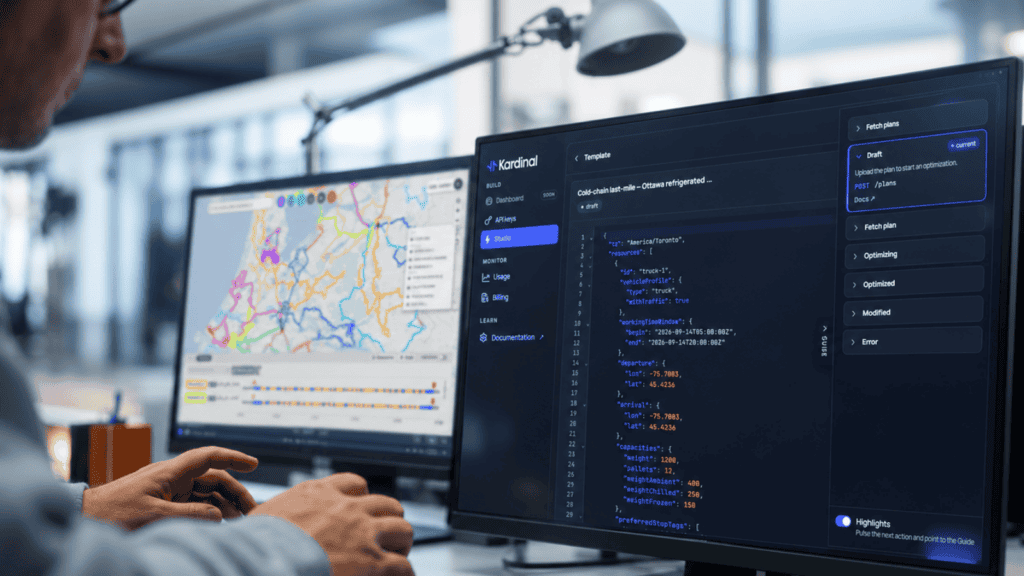
Billing models differ widely (per stop, per resource, per credit, per request), which makes any direct comparison difficult. The billing unit matters as much as the unit price.
When evaluating a route optimization API, pricing transparency is one of the first signals of how a vendor views developers. A vendor that publishes clear pricing trusts developers to judge the product on its merits. A vendor that hides its prices behind a “contact us” form is betting you will be too deep into the integration to walk away once you discover the real cost.
This article breaks down the pricing models of eleven route optimization APIs, compares their free tiers and explains why the choice of billing unit matters as much as the unit price.
Key takeaways
Why pricing transparency matters to developers
Integrating a route optimization API is not a trivial decision. It involves several weeks of engineering work, data modelling and testing against real operational data. By the time a developer has validated the API on their use case, the cost of switching is significant.
A vendor that requires a sales call before disclosing any price knows this. The absence of public pricing is not an oversight, it is a deliberate strategy to capture developers before they can make an informed comparison. Transparent pricing, by contrast, lets you estimate total cost before committing, compare APIs on a cost-per-stop basis without a sales conversation, plan predictable infrastructure costs and get started on your own.
The good news: most APIs have moved to public pricing. The bad news: billing models are so heterogeneous that comparing them takes real translation work.
Which APIs publish their pricing?
Kardinal
Public pricingA French company founded in Paris in 2015, Kardinal is entirely dedicated to route optimization. The API is the core of the product, not one module among many. The R&D team, made up of PhDs in applied mathematics, built a proprietary engine designed for complex operations, and the most complete on the market in terms of operational constraint coverage. The engine is available through three channels: a self-service API for developers, a SaaS solution for operations teams and a mobile app for drivers.
Billing model
Kardinal bills per unique stop within a plan, per 24-hour window. The same location optimised several times in the same plan on the same day is billed only once. You pay for stops, not requests: re-optimising during the day costs nothing extra, and if you add deliveries you only pay for the stops you added.
| Stops included | Price | Price / stop |
|---|---|---|
| 2,000 | €99 | €0.050 |
| 10,000 | €299 | €0.030 |
| 50,000 | €999 | €0.020 |
| 250,000 | €2,999 | €0.012 |
| Millions of stops | Contact sales | n/a |
Packs are not subscriptions: no expiry, no commitment. An alert is sent at 80% consumption, then the last pack auto-renews at 90% to avoid any interruption. Auto-renewal is on by default and can be turned off.
Worked examples
= 2,100 stops/month
= 105,000 stops/month
Limits to know
Because packs are prepaid, there is no fixed monthly cost: you buy more stops when you need them, with or without auto-renewal. The upside is the absence of commitment; the trade-off is a monthly cost that varies with actual usage.
Routific
Public pricingA Canadian company founded in Vancouver, Routific focuses exclusively on last-mile delivery for small and mid-sized fleets. They offer an API for developers, a web interface for operations teams and a mobile app for drivers.
Billing model
Routific bills a monthly subscription, with a well-defined unit: the visit, meaning a unique address optimised within a 24-hour window. Optimise the same address several times in one day and it counts only once.
| Tier | Visits/month | Price/month | Price/visit |
|---|---|---|---|
| Pro Tier 1 | 1,000 | $150 | $0.150 |
| Pro Tier 2 | 2,000 | $275 | $0.138 |
| Pro Tier 3 | 5,000 | $600 | $0.120 |
| Pro Tier 4 | 15,000 | $1,500 | $0.100 |
| Overage | Above the tier | $0.15/extra visit | $0.150 |
| Enterprise | Above 15,000 | On quote | from $0.050 |
Worked examples
= 2,100 visits/month
= 105,000 visits/month
Limits to know
Above 15,000 visits/month, Enterprise plan only. Overage on a tier is billed at $0.15 per extra visit: it can sometimes be cheaper to move up a tier than to stay on Pro Tier 3 with overage.
Verso (Vroom Premium API)
Public pricingVerso is the commercial offering built around VROOM, an open-source VRP solver. It provides hosted, metered access to the VROOM engine without having to run the infrastructure yourself.
Billing model
Verso calls each stop to optimise a task. Pricing works in progressive bands: each band is billed at its own rate, independently of the previous ones. The first 2,000 tasks cost €0.040 each, the next 4,000 cost €0.030, and so on.
| Task band | Price / task | Band cost |
|---|---|---|
| 0 to 2,000 | €0.040 | €80 |
| 2,001 to 6,000 | €0.030 | €120 |
| 6,001 to 14,000 | €0.020 | €160 |
| 14,001 to 30,000 | €0.015 | €240 |
| 30,001 to 70,000 | €0.010 | €400 |
| 70,001 to 170,000 | €0.0075 | €750 |
| 170,001 to 480,000 | €0.0050 | €1,550 |
| Above 480,000 | Contact sales | n/a |
Three examples of how the bands add up
5 veh. × 20 stops × 21 days
100 veh. × 50 stops × 21 days
Limits to know
Billing minimum: €20/month. Above 480,000 tasks/month you need to contact the Verso team. Their policy on re-billing re-optimisations beyond one hour should be checked with them directly before integrating.
Google Route Optimization API
Public, complexGoogle Maps Platform is one of the largest location platforms in the world. The Route Optimization API is one product among dozens in the Google Maps ecosystem: route optimization is not Google's core business, it complements a reference mapping infrastructure.
Billing model
Google bills the Route Optimization API per stop. The amount charged for a request equals the number of stops it contains, multiplied by the SKU unit price. There are two SKUs depending on vehicle count: Single Vehicle Routing (1 vehicle, Pro category) and Fleet Routing (2 or more vehicles, Enterprise category).
The direct consequence: every re-optimisation re-bills all the stops in the request. Re-optimising a 300-stop route three times costs 900 units.
| Plan | Price/month | Calls included | Includes optimization? |
|---|---|---|---|
| Essentials | $275 | 100,000 | No |
| Pro | $1,200 | 250,000 | Single Vehicle only |
On pay-as-you-go Fleet Routing: 1,000 free stops per month (a recurring Enterprise SKU quota), then a volume-discount grid per 1,000 stops, from $30 down to $2.10 depending on monthly volume, plus $300 in credits when creating a Google Cloud account. Not billed: requests that fail validation, requests sent in VALIDATE_ONLY mode, and stops that are infeasible or skipped by the solver.
Worked examples
= 2,100 stops/month
= 21,000 stops/month
If the same fleet is re-optimised three times a day, billed volume triples. This is what separates Google most sharply from 24-hour-window models.
Limits to know
The difficulty with Google is not the unit price but how scattered the information is: the pricing grid, the free quotas per SKU category and the product documentation live on three different pages. Two mistakes come up often. Many teams count an optimization as a billed event, when it is the number of stops in the request that counts: a 20-vehicle fleet optimised once a day costs around $600/month, not zero. Others mistake the “Enterprise” SKU category for a negotiated contract: there is no Enterprise subscription, and Fleet Routing remains available self-service at the pay-as-you-go rate.
GraphHopper
Public pricingA German company founded in Berlin, GraphHopper started as an open-source routing project and grew into a commercial API covering routing, geocoding and route optimization. Open source remains central to its identity, with a free plan and a self-hosted version.
Billing model
GraphHopper bills in credits. The cost of an optimization is #vehicles × #locations, bounded on both sides: a request costs at least 10 credits and at most 10 × #locations. A small request (1 vehicle, 5 locations) is therefore billed 10 credits, and the vehicle multiplier caps at 10: beyond ten vehicles, cost grows only with the number of locations. A problem with 50 vehicles and 1,000 stops thus costs 10,000 credits, not 50,000.
| Plan | Price/month | Credits/day | Max veh. | Max loc. |
|---|---|---|---|---|
| Free | €0 | 500 | 1 | 5 |
| Basic | €69 | 5,000 | 2 | 30 |
| Standard | €199 | 15,000 | 10 | 80 |
| Premium | €479 | 50,000 | 20 | 200 |
| Custom | Contact | Custom | 200 | 10,000 |
No monthly commitment, with roughly 25% off on annual billing.
Worked examples
≈ 101 unique locations
≈ 5,000 locations/request
Limits to know
The 200-location cap per request applies to all unique points: depots, end points and stops. Even with a shared depot, 10 vehicles with 40 stops each amount to more than 400 locations, twice the Premium cap. The bigger the fleet, the less room is left for stops: on Premium, 10 vehicles allow roughly 18 to 19 stops per route, and 20 vehicles 8 to 10. You can work around the cap by splitting the fleet into sub-groups: credit cost does not suffer, but each sub-group is optimised in isolation, with no reassignment of a stop from one group to another, which mechanically degrades the result.
Solvice (OnRoute)
Public pricingA Belgian company specialised in algorithmic optimization: routing, workforce planning and scheduling, with an approach geared toward complex European use cases.
Billing model
Solvice bills per resource per month, with a minimum of 10 resources, i.e. €160/month. That is the only truly published pricing element; the tiers below are indicative and the grid changes regularly, so re-check before committing.
| Resources/month | Price / resource / month |
|---|---|
| 1 to 50 | €16 |
| 51 to 100 | €14 |
| 101 to 250 | €10 |
| 251 to 500 | €9 |
| Above 500 | Contact sales |
Worked examples
Limits to know
Billing minimum: 10 resources, i.e. €160/month. Above 500 resources you need to contact the sales team. How it compares with per-stop APIs depends on volume: from roughly 50 stops per vehicle per day, this model generally becomes the better deal.
Geoapify
Public pricingA German company offering a full platform of geospatial APIs: geocoding, routing, isochrones, place search and route optimization. Optimization is not its main specialty, it is one API among many.
Billing model
The cost of an optimization depends on the number of locations in the request: n × n credits below 10 locations, n × 10 above. For any real fleet the maths is therefore simple: 10 credits per location. Example: 38 locations (30 jobs + 7 vehicles + 1 shared depot) = 380 credits per request.
| Plan | Price/month | Credits/day |
|---|---|---|
| Free | €0 | 3,000 |
| API 10 | €49 | 10,000 |
| API 25 | €89 | 25,000 |
| API 50 | €149 | 50,000 |
| API 100 | €249 | 100,000 |
| API 250 | €499 | 250,000 |
| Custom | From €700 | Custom |
There is no pay-as-you-go option.
Worked examples
106 loc. = 1,060 credits/day
511 loc. = 5,110 credits/day
5,101 loc. = 51,010 credits/day
Limits to know
In synchronous mode, a request cannot exceed 300 locations. For a fleet of 10 vehicles with 50 stops each, the total is already 511 locations: you have to split into several requests. The credit cost stays the same, but splitting degrades optimization quality.
HERE Technologies (Tour Planning)
Public up to 200kA Dutch company founded in Amsterdam, HERE Technologies is one of the world's major map data players, owned by a consortium of industrial groups. The Tour Planning API is one product within a vast range of geospatial services.
Billing model
A transaction is the sum of all locations in the request: start points, end points and stops.
| Transactions/month | Price / 1,000 transactions |
|---|---|
| Up to 500 | Free |
| 501 to 40,000 | €27.98 |
| 40,001 to 200,000 | €22.39 |
| Above 200,000 | Contact sales |
Worked examples
= 2,226 transactions/month
= 107,121 transactions/month
Limits to know
Tour Planning is excluded from HERE's general freemium tier. Above 200,000 transactions/month you need to contact the sales team.
Mapbox Optimization API
v1 public · v2 betaAn American company founded in San Francisco, Mapbox is a reference in developer-facing mapping APIs. Route optimization there is a secondary feature: it is also the API covering the fewest operational constraints in the benchmark (14% of the constraints analysed).
Billing model
v1 bills per API request, not per stop: a request containing several waypoints is billed as a single request. It is limited to 12 coordinates per request on standard plans, a limit that can be raised on request for some accounts, and beyond 10 coordinates the results are optimised approximations. The free tier is therefore generous on paper, but a single-vehicle 12-point TSP covers no fleet use case: v1 targets small one-shot problems.
| Requests/month | Price / 1,000 requests |
|---|---|
| Up to 100,000 | Free |
| 100,001 to 500,000 | $2 |
| 500,001 to 1,000,000 | $1.60 |
| Above 1,000,001 | $1.20 |
| Above 5,000,000 | Contact sales |
v2 (Public Beta) supports up to 1,000 locations and multiple vehicles, but access requires manual sign-up and no pricing is published.
Example: 5 vehicles, 20 stops/day
v1 unusable (5 vehicles exceeds the single-vehicle TSP limit). v2 technically compatible but in beta, with no published pricing.
Limits to know
v1 only covers a single-vehicle 12-coordinate problem: it is out of scope for a fleet. v2, the only version genuinely usable for VRP, has no public pricing.
Which APIs require a sales call to get a price?
Two APIs show no public pricing at all: NextBillion.ai and Timefold. Getting a price always requires contacting their sales team before any integration.
NextBillion.ai
No pricingFounded in 2020 in Singapore by three former members of Grab's mapping team, NextBillion.ai offers a mapping and optimization platform aimed at large enterprises, with offices in Singapore, Hyderabad and Columbus, Ohio. The company was acquired in October 2025 by US-based Velocitor Solutions.
Limits to know
There is no way to estimate total cost before committing to the integration, or to compare on a cost-per-stop basis without a sales conversation.
Timefold
No pricingA Belgian company born out of OptaPlanner, an open-source planning project formerly maintained by Red Hat. Timefold specialises in algorithmic optimization in the broad sense.
Limits to know
With no published billing unit, there is no way to model how the bill will evolve as the fleet grows.
How to choose your route optimization API
Asking the right questions
Each API uses its own unit: stop, task, visit, transaction, credit or request. These are not synonyms: the unit determines what you pay for and how your bill evolves. Three questions determine which model fits your operation.
How many optimizations do you run per day?
If you re-optimise frequently (handling disruptions, adding orders during the day), APIs billed per request or per transaction (Google, HERE, Geoapify) multiply your costs. Stop packs (Kardinal) and fixed subscriptions (Solvice, Routific) stay the same whatever the frequency.
How regular is your activity?
A fixed monthly subscription (GraphHopper, Solvice) makes you pay through quiet periods too. Prepaid packs with no expiry (Kardinal) follow your actual rhythm: you buy more when you need it.
How big is your fleet?
Some models carry a billing minimum (Solvice: 10 resources, €160/month) or a structural limit (Geoapify: max 300 locations per request, GraphHopper: max 200 locations) that can degrade optimization quality for large fleets.
Spotting the most transparent and suitable API
Pricing summary for the 11 APIs
| API | Public price | Billing unit | Free tier | Entry price |
|---|---|---|---|---|
| Kardinal | Yes | Unique stop per plan per 24 h · prepaid packs | 1,000 stops on sign-up | €99 · 2,000-stop pack |
| Verso | Yes | Optimised task, volume discounts | Free to integrate · €20/month min. | €0.04/task, down to €0.005 |
| Routific | Yes | Monthly subscription (visits/month) | 30-day trial · 1,600 addresses | $150/month · 1,000 visits |
| Yes, scattered docs | Stop per request, every re-optimisation re-billed | 1,000 stops/month, recurring | $30/1,000 stops, down to $2.10 | |
| GraphHopper | Yes | Credits per request (veh. × loc., capped) | 500 credits/day, non-commercial | €69/month · Basic |
| Solvice | Yes | Per resource / month | 30-day trial · 10 veh./day | €16/resource/month |
| Mapbox | v1 yes · v2 no | v1: per request, max 12 points | 100,000 requests/month (v1) | $2/1,000 requests (v1) |
| Geoapify | Yes | Credits/day, monthly subscription | 3,000 credits/day · Free plan | €49/month · API 10 plan |
| HERE | Yes, quote > 200k | Per transaction (sum of locations) | 500 transactions/month | €27.98/1,000 transactions |
| NextBillion.ai | Not published | Not published | Guided 2-3 week trial | Not published |
| Timefold | Not published | Not published | On request | Not published |
Monthly cost by fleet profile
Monthly estimates for two fleet profiles and two optimization frequencies. USD converted to EUR (× 0.92).
| API | 5 veh. · 20 stops/day 1 opt/day | 5 veh. · 20 stops/day 3 opts/day | 100 veh. · 50 stops/day 1 opt/day | 100 veh. · 50 stops/day 3 opts/day |
|---|---|---|---|---|
| Geoapify ⚠ | €0 | €49 | €249 | €499 |
| Kardinal | €63 | €63 | €1,260 | €1,260 |
| HERE | ~€48 | ~€173 | ~€2,608 | Contact sales |
| Verso | ~€83 | ~€206 | ~€1,263 | ~€2,475 |
| Solvice | €160 | €160 | €1,500 | €1,500 |
| ~€30 | ~€146 | ~€2,870 | ~€8,670 | |
| Routific | ~€267 | ~€267 | ~€4,830 | ~€4,830 |
| GraphHopper | €479 | €479 | Custom required | Custom required |
| Mapbox | v1 incompatible | v1 incompatible | v1 incompatible | v1 incompatible |
| NextBillion.ai | Contact sales | Contact sales | Contact sales | Contact sales |
| Timefold | Contact sales | Contact sales | Contact sales | Contact sales |
Geoapify ⚠: from 100 vehicles onwards, the 300-location cap per request forces a split into ~18 independent sub-groups. The price is reasonable but the optimization is no longer global.
Google: priced per stop at the first tier ($0.03/stop), without applying volume discounts. The 100-vehicle figures are therefore upper bounds; at those volumes, the discount grid noticeably reduces the real bill.
Kardinal: the amounts are amortised, not billed monthly. You buy a prepaid pack that covers several months, then buy again when the balance runs out. At 2,100 stops/month, a 10,000-stop pack (€299) lasts 4.8 months, i.e. €63/month amortised for an actual spend of €299 roughly every five months. At 105,000 stops/month, a 250,000-stop pack (€2,999) covers 2.4 months, i.e. €1,260/month. With no deadline and no commitment, a quiet period simply pushes back the next purchase instead of billing you for nothing.
For small fleets (5 vehicles, 20 stops), Geoapify is the only free option at 1 optimization per day, and Google the cheapest paid one (~€30) as long as you optimise once a day: its cost triples at 3 optimizations (~€146). Then come HERE (~€48), which follows the same re-billing logic, and Kardinal (€63), stable whatever the frequency. Routific (~€267) and GraphHopper (~€479) are significantly more expensive at these volumes.
Re-optimisation frequency splits the APIs into two clear camps. Kardinal, Solvice and Routific cost the same whatever the frequency. Verso, HERE and Google multiply their cost in direct proportion to the number of re-optimisations: Verso goes from €83 to €206/month for 5 vehicles at 3 optimizations/day, Google from €30 to €146.
At large fleet scale (100 vehicles, 50 stops), Geoapify remains theoretically the cheapest (€249) but the 300-location cap per request forces a split into 18 sub-groups of ~16 vehicles, optimised independently. Kardinal (€1,260) and Verso (~€1,263) are near identical at 1 optimization per day, but Verso doubles to €2,475 at 3 optimizations/day while Kardinal stays flat.
Simulator: which API is cheapest for your fleet?
Enter your average fleet: the table translates that volume into each API's billing unit and shows the matching monthly cost, on a 21-working-day basis. APIs whose public grid does not cover that volume appear greyed out, with the reason for the cap. The table does not pick a winner, it translates each grid into its own unit.
| API | What you pay for | Billed volume | Cost / month |
|---|
Estimates calculated from the public pricing grids cited in this article, over 21 working days, a single shared depot, converted at $1 = €0.92. Kardinal and Routific count an address only once per 24-hour window: increasing the number of daily optimizations does not change their bill. Verso, Google, GraphHopper, Geoapify and HERE re-bill every request. The Kardinal cost is the pack price amortised over the period it covers, never a monthly subscription. Check with each vendor before committing.
Sign up without a credit card, with documentation and SDKs available immediately. Within the 24-hour window, re-optimisations count nothing extra.
FAQ
Which route optimization APIs have public, transparent pricing?
Nine of the eleven APIs analysed publish pricing: Kardinal, Verso, Routific, Google, GraphHopper, Solvice, Mapbox, Geoapify and HERE Technologies. HERE publishes a complete grid up to 200,000 transactions per month and moves to quotes above that. NextBillion.ai and Timefold publish no pricing at all.
Which pricing model suits developers best?
The best-suited model is billing per unique stop per plan, with no recount on re-optimisation. Kardinal and Routific (Engine API) work this way; Verso also bills per task but re-bills every request, and therefore every re-optimisation. Kardinal goes further with prepaid packs that never expire: you buy when you need to, with no forced subscription, and the 1,000 free stops on sign-up give access to the whole product without a credit card.
Can you evaluate a route optimization API for free?
Yes, most APIs offer a free tier. The most useful for a serious evaluation are Geoapify (3,000 credits/day, unlimited in time), Routific (30-day trial, max 1,600 addresses) and Kardinal (1,000 free stops on sign-up, no credit card).
Which API is cheapest at scale?
At high volume (several million stops per month), Google's lowest rate ($0.0021/stop) is among the lowest published unit costs. Subscription models like GraphHopper or per-resource models like Solvice can be more economical for stable, high-volume operations. The most important variable remains the API's ability to model your constraints: a cheap API that requires manual correction of every result is not actually cheaper.
What is the difference between a credit system and per-stop billing?
They are two different logics. In a prepaid pack system like Kardinal's, you buy a volume of stops in advance and consume them at your own pace, with no expiry. In pay-as-you-go per-stop billing, you pay after consumption. In a monthly subscription (GraphHopper, Routific), you pay a fixed fee regardless of actual usage.
Which API is cheapest for a small fleet of 3 to 5 vehicles?
At low volumes, Geoapify is the only genuinely free option over time (3,000 credits/day, no credit card); Routific offers only a 30-day trial, and Kardinal 1,000 free stops on sign-up. Solvice is not suited to small fleets, its billing minimum being 10 resources (€160/month). GraphHopper starts at €69/month. For fleets that are growing, per-stop models like Kardinal or Verso are more economical because they only bill what is actually optimised.
Can you use the Kardinal API without going through a salesperson?
Yes. Kardinal is built for fully self-service access: sign-up without a credit card, 1,000 free stops available immediately on the complete product, documentation and SDKs available with no sales contact. When the free stops run out, you buy a pack. That is a structural difference from NextBillion.ai and Timefold, where even knowing the prices requires talking to a salesperson.
Which API has the most generous free tier?
Geoapify has the most generous free tier in absolute volume: 3,000 credits per day, permanent and with no credit card. Kardinal gives 1,000 stops on sign-up, no credit card and with access to the complete product, but as a one-off. Google gives 1,000 free stops/month on a recurring basis. GraphHopper has a free plan, restricted to non-commercial use.
Going further


Parcel delivery
Stop density, strict time windows and daily disruptions: the constraints that separate the APIs on the last mile.
Read the full analysis →
Fresh and frozen food
Temperature compartments, secured access and cold-room returns: the sector with the toughest compliance demands.
Read the full analysis →
Long haul / FTL
Regulation, driving time and rate modelling on full truckload.
Read the full analysis →