


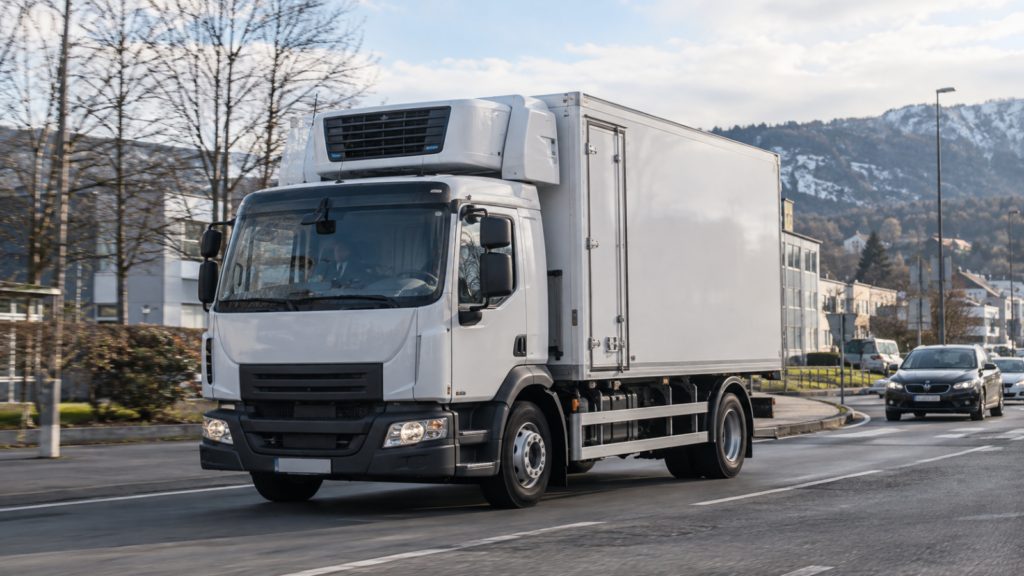
Among route optimization APIs for fresh food delivery, Kardinal dominates this sector ranking by a wide margin. Temperature compartment configuration, the heart of cold-chain work, is fully covered by only three of the eleven solutions: Kardinal, NextBillion AI and Solvice.
The cold chain places constraints on route optimization that few other sectors combine: multi-temperature goods that cannot share a compartment, secured cold-room access whose keys travel on a single keyring, short delivery windows before the served venues open, and frequent return trips to the cold room to reload. Badly planned, a fresh-food delivery breaks the cold chain, triggers a food-safety non-conformity and immediate contractual penalties.
This article compares eleven route optimization APIs (Kardinal, Solvice, LogisticsOS, NextBillion AI, HERE, Google, GraphHopper, Timefold, Verso, Routific, Mapbox) on their ability to handle the specific constraints of chilled and frozen food delivery.
Key takeaways
What makes fresh food delivery genuinely complex
Multi-temperature goods
A single route can include dry goods, chilled goods (between 0°C and 4°C) and frozen goods (below -18°C). These categories cannot share an unpartitioned compartment. The optimizer has to pick the vehicle configuration best suited to the assigned load: all chilled, all ambient, or split across several compartments.
Secured access and carrier continuity
Some venues are served through a secured airlock or a cold room whose physical keys sit on a single keyring. Only the driver carrying it can serve those sites, which forces their stops onto one route. On long-term supply contracts, keeping the same carrier or the same regular driver also simplifies the customer relationship.
Short delivery windows before service opens
Restaurants, bars and hotels want to be served as early as possible before their own service opens, so that cold-chain goods arrive with as much margin as possible before use. That window is often stricter than for other types of business.
Frequent return trips to the cold room
A limited refrigerated fleet often has to run several routes a day, coming back to reload at the cold room between two sequences, while keeping goods in temperature-controlled storage between trips.
Cold-chain-specific carbon reporting
Cold-chain customers are often demanding on environmental reporting: beyond optimizing total CO2 across a heterogeneous fleet, you need to compute it per delivery, per customer or per pallet to back up the figures passed downstream.
The critical constraints for a fresh food delivery API
Three levels of requirement structure the market: the classic baseline everyone covers, the intermediate constraints that are indispensable in practice, and the advanced constraints that genuinely make the difference in the cold chain.
Minimising lateness before service opens
Delivering as early as possible before the venue starts its own service.
Covered by: Kardinal, Routific, Timefold, NextBillion AI, Solvice, Google, HERE and LogisticsOS. Absent at GraphHopper, Mapbox and Verso.
Pickup and delivery within the route
The core movement of the business.
Covered by: Every vendor.
Goods that cannot travel together
Preventing frozen, chilled and ambient goods from sharing a single-temperature vehicle.
Covered by: Kardinal, Timefold, NextBillion AI, Solvice, GraphHopper, Google, HERE and LogisticsOS. Absent at Routific, Mapbox and Verso.
Workload balancing across routes
Spreading the workload across the fleet's drivers.
Covered by: Kardinal, Routific, NextBillion AI, Solvice, GraphHopper and LogisticsOS.
Several trips a day from the cold room
Chaining routes with a reload stop between two sequences.
Covered by: Every vendor except Routific and Timefold.
Maximum route distance
Keeping the route within the range of an electric refrigerated vehicle.
Covered by: Every vendor except Routific, Timefold and Mapbox.
Preferred carrier for the regular customer base
Preserving continuity with the carrier that usually serves an area or a customer.
Covered by: Kardinal, Timefold, Solvice, GraphHopper, HERE and LogisticsOS.
Carbon reporting per delivery or per customer
Computing total CO2 and allocating it precisely for customer reporting.
Covered by: Kardinal and Google. Partial at HERE.
Temperature compartment configuration
Choosing the vehicle configuration best suited to the load: all chilled, all ambient, mixed.
Covered by: Kardinal, NextBillion AI and Solvice only.
Time windows specific to the assigned vehicle
Widening the delivery window when the assigned driver has badged access to the cold room.
Covered by: Kardinal only, out of the 11 solutions tested.
Maximum distance from the cold room
Capping how far a refrigerated route can stray from its start site.
Covered by: Kardinal only. Partial at NextBillion AI, Solvice and LogisticsOS.
Lexicographic optimization
Ranking objectives without weighting: temperature first, distance second. Without it, every criterion needs its own weight, and the configuration quickly turns into a sprawling setup to fine-tune.
Covered by: Kardinal and HERE only.
Keyring-holder exclusivity
Forcing all secured-airlock stops onto the route of the driver holding the keys.
Covered by: Kardinal, NextBillion AI, Solvice, GraphHopper, Google, HERE and LogisticsOS.
The fresh food delivery APIs compared
Kardinal
98% coverage · 1st/11Kardinal is the most complete solution for the cold chain. It is the only vendor, alongside NextBillion AI and Solvice, to dynamically configure temperature compartments based on the load, and the only one to fully cover maximum distance from the cold room and time windows that depend on the driver assigned to a secured site.
Its only gap in this sector concerns a very niche need: time-of-day-dependent hourly cost, available only from Solvice.
Solvice
80% coverage · 2nd/11Solvice takes second place. It joins Kardinal and NextBillion AI on temperature compartment configuration, and has one strength Kardinal does not cover: modelling hourly cost by time of day, relevant for the night and early-morning deliveries common in the cold chain.
Its limit: no lexicographic optimization. With a model that rich, balancing several objectives means setting a weight on each criterion, and the configuration quickly becomes a heavy machine to fine-tune.
LogisticsOS
79% coverage · 3rd/11LogisticsOS stands out on cost modelling: it joins Kardinal on flat-rate and overtime thresholds as well as combined invoice optimization between own fleet and subcontracted carriers.
NextBillion AI
75% coverage · 4th/11NextBillion AI joins Kardinal and Solvice on temperature compartment configuration, a rare capability on this market. It also covers predictive traffic and keyring-holder exclusivity well. What it lacks: continuity with the regular carrier is not covered, maximum distance from the cold room is only partially covered, and lexicographic optimization is absent.
HERE
74% coverage · 5th/11HERE is the only solution besides Kardinal to offer lexicographic optimization. It covers keyring-holder exclusivity and predictive traffic well, but does not configure temperature compartments and does not cover maximum distance from the depot.
Google covers per-delivery carbon reporting well, on a par with Kardinal, along with predictive traffic. It configures neither temperature compartments nor maximum distance from the cold room.
GraphHopper, Timefold, Verso, Routific and Mapbox
56% → 29%- GraphHopper (56%) covers keyring-holder exclusivity and predictive traffic, but not temperature compartment configuration or lexicographic optimization. It remains suited to small volumes.
- Timefold (50%) lags on most of the sector's fundamentals.
- Verso (45%), Routific (40%) and Mapbox (29%) are not designed for the professional cold chain: none configures temperature compartments or handles exclusive access to secured sites.
Summary table
| Solution | Coverage | Temperature compartments | Windows per assigned vehicle | Predictive traffic | Lexicographic |
|---|---|---|---|---|---|
| Kardinal | 98% | Full | Full | Full | Full |
| Solvice | 80% | Full | No | Full | No |
| LogisticsOS | 79% | No | No | Partial | No |
| NextBillion AI | 75% | Full | No | Full | No |
| HERE | 74% | No | No | Full | Full |
| 73% | No | No | Full | No | |
| GraphHopper | 56% | No | No | Full | No |
| Timefold | 50% | No | No | No | No |
| Verso | 45% | No | No | No | No |
| Routific | 40% | No | No | No | No |
| Mapbox | 29% | No | No | Full | No |
Our verdict
Fleet size is not what should drive the choice. What matters is how much of your operation goes beyond the classic constraints. Start from the five leading solutions on the cold chain, then narrow the list according to your needs.
Test Kardinal optimization on your own data, with no commitment.
FAQ
Which optimization API should you choose for fresh food delivery?
Kardinal is the most complete solution for the cold chain, with 98% sector coverage, and the most competitive on price among the top 5. Solvice (80%) and LogisticsOS (79%) follow, ahead of NextBillion AI (75%) and HERE (74%). For multi-temperature loads, the shortlist narrows to Kardinal, Solvice and NextBillion AI; with a carrier-continuity requirement on top, to Kardinal and Solvice.
How do you optimize deliveries with chilled, dry and frozen goods on the same route?
Multi-temperature handling requires the optimizer to choose the vehicle configuration (all chilled, all ambient, mixed) best suited to the assigned load. Kardinal, NextBillion AI and Solvice cover this capability. The other solutions only prevent incompatible goods from sharing a compartment, without optimizing the configuration itself.
How do you handle deliveries into cold rooms with secured access?
Some sites are served through an airlock or a cold room whose keys sit on a single keyring, which forces all their stops onto the keyholder's route. Seven of the eleven solutions tested handle this exclusivity: Kardinal, NextBillion AI, Solvice, GraphHopper, Google, HERE and LogisticsOS. Kardinal is also the only one to automatically widen the time window depending on whether the assigned driver has that access.
Do optimization APIs include carbon reporting for the cold chain?
Computing CO2 per delivery or per customer, rather than one aggregate fleet total, is available from Kardinal and Google, with partial coverage at HERE. The other solutions do not allow this fine-grained allocation, which limits their use for customers demanding on environmental reporting.
How do you plan several routes a day from the same cold room?
Most of the solutions tested let a refrigerated vehicle run several routes a day, coming back to reload at the cold room between two sequences. Only Routific and Timefold do not cover it among the 11 solutions tested.
Going further


Long-haul / FTL
Regulation, driving hours and rate modeling on full truckload.
Read the full analysis →
Parcel delivery
Stop density, strict time windows and daily disruptions: the constraints that separate the APIs on the last mile.
Read the full analysis →
Waste transport
Tipping-site intake capacity and simultaneity: the sector worst served by the market.
Read the full analysis →